Main menu:

Join Newsletter

Athlete Login
Username
Password

Links:

@GoMomentum

Site search

_______________________________

Travis_Woodruff_Momentum_Endurance_CoachMomentum Endurance LLC is your source for endurance coaching.  Take a look through the pages to see how Momentum can benefit athletes of all experience levels.  Don’t hesitate to contact us with questions or for additional information.

Thanks for stopping by,

Travis Woodruff

2013 World Cyclocross Championships

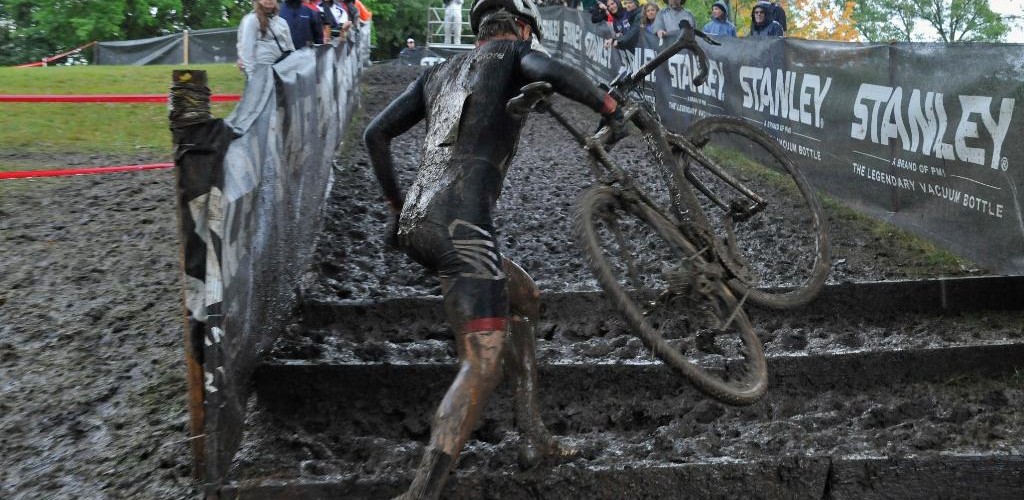
I was fortunate enough to make the travels to Louisville, KY this past weekend and experience the World Championships of Cyclocross. What an action-packed and memorable day it was with four races (Juniors, U23, Elite Women, and Elite Men) to take in!  More than anything I was proud to “bring the noise” and wave the American flag while racers ripped around a World Championship course for the first time ever on US soil.  In the photo above you can see the US flag that I was waiving just in front of the 25m to go sign.

Racing in your own country at an event of this caliber is something that only a few professional US racers will ever get to experience so it was fun to cheer them on course-side. You could feel the significance of this every time a US rider sped by and the  crowd noise levels would literally double.

The US did cyclocross proud on the World’s stage and it was incredible to experience it with so many friends and cyclocross enthusiasts who were there to make it all that it was.  If you missed it in person, you can still check out the recorded action here:  Juniors, U23, Elite Women, Elite Men via YouTube. Enjoy,

Epic Ride on the AZ Trail

Brian got some great video footage from the big MTB ride that we did on Sunday. Enjoy!

Thinking of 2013 yet?

Sunrise over the Tucson Mountains.

As the year winds down most of us find ourselves thinking of next season and plotting how might we might improve our performance at some of the bigger races. Even if you achieved stronger than ever fitness this year, was it well timed relative to your goal events? There are so many factors that can improve your performance it can be tough to prioritize them. We’ve organized a training camp that is designed to answer some of these questions for you and equip you for an excellent 2013 season.

Join us for our Tucson Training Camp, February 19th – 24th. This camp goes well beyond guided rides in the sunshine and you’ll have loads of one on one interaction with coaches who know know ‘what it takes’ to consistently improve and move up the ranks. You’ll have the opportunity to learn what types of rides or workouts are most appropriate at various stages of your season. Our goal is to equip you with knowledge so that you not only have a successful camp with us, but more importantly, you return home better prepared to make 2013 your best season ever.

Make plans to jump start your season with us in Tucson and reserve your spot with us! For more details you can check out our Tucson Training Camp page. Please feel free to contact us with any questions. We look forward to riding with you.

A question on weight training

This Q&A article recently appeared on MTBRaceNews.com. You can read it there with this link, or simply continue on below. As always, please feel free to contact Momentum Endurance if we can help you with a pressing question that you might have. Thanks,

Question: How can weight lifting and other gym cross training be beneficial to mountain bike racing, mainly endurance racers? (Submitted by: Cody Pratt -Visalia, California)

Hi Cody,

You’ve asked a great question and it’s likely one that many riders share. The benefit of resistance training and its application for endurance cyclists has long been hotly debated.  Unquestionably there are benefits to be gained from weight lifting or other ‘gym cross training’ (let’s use the term resistance training since it includes weight training and also strength exercises which only require body weight). What can be questioned, however, is the specificity of resistance training. Will it help you ride a mountain bike any faster? Also, might time spent doing resistance training be better spent by doing more work on the bike instead?

Outlining the benefits

With resistance training an improved ability to create higher forces and better fatigue resistance can be expected. Also with resistance training the rate of recovery will improve so that harder workouts can be done with greater frequency. If you’ve followed a resistance training program before you’ve likely noticed that you get stronger and that you’re able to recover faster after workouts. Resistance training can be a great full body workout and you can focus on muscle groups that might otherwise be under developed or neglected as the result of bike-only training. Maintaining a strong upper body and core with resistance training may benefit your posture too.  Another important consideration, especially so for women, is that resistance training can benefit bone health since it is weight bearing and typically includes eccentric muscle contractions. These are just a few of the numerous benefits that come with resistance training. Notice however that I didn’t mention that you’ll be able to pedal your bike at a higher power output for a longer duration – this is something that no resistance training study has been able to demonstrate.

Specific Adaptation to Imposed Demands

While resistance training benefits are quite clear for overall health and wellness considerations, the competitive cyclist might say, “okay that’s all great, but is resistance training going to help me race faster?” The short answer is no and that’s where the concept of specificity comes in. There will bespecific adaptation to imposed demands that are placed upon the body. Any set of training adaptations may not transfer to other activities. This is the SAID principle. In a nutshell, you get good at doing what you do, and not necessarily so good at the things you’re not doing. Since resistance training differs considerably with racing a mountain bike, it is unlikely that any benefits will allow you to pedal harder or to ride faster.

How best to apply?

Perhaps the most important question to consider is this: how should resistance training be applied into your cycling specific program? It is safe to say that it’s the training that you do on the bike that will benefit your riding the most. If you’re already putting in adequate training time on the bike and have additional time and energy for resistance training it will make your program better-rounded. I encourage riders to approach the resistance training as something that is supplemental to their program this way rather than something that is imperative. Most cyclists should keep with a well-rounded program which includes some resistance training done once or twice per week. Those who are racing at the highest level and pushing their training to the absolute limit may find that resistance training reduces the amount of training that they’d otherwise be able to do during critical training periods. For them, it’s all about maximizing the bike training and also their recovery, so resistance training isn’t the best option in this situation. So while you might not want to include resistance training when your bike training workload is at its highest, you’ll likely want to incorporate it during the bulk of the year otherwise.

Thanks for sending across your question Cody! Best of luck with your training.

-Travis

Now offering Quarq Powermeters

If you aren’t already training with power, perhaps this is the year to finally do so. Maybe you’ve been training with power for awhile now, but you’re growing tired of being limited to just one rear wheel with your current hub-based powermeter.

Either way, you should check out the wireless crank-based powermeters that are made by Quarq in Spearfish, SD. Quarq offers several versions so that you can choose the best option for your application. You can go with standard or compact chainrings on a SRAM, FSA, Rotor, Specialized, or Cannondale crankset. Also offered is a 2×10 SRAM MTB powermeter.

Quarq provides all of the performance and reliability of other crank-based powermeters, but at a fraction of the cost. All Quarq powermeters have a user replaceable battery too which means that with this system, you won’t have the expense/hassle of sending it away for service every year. This is the same powermeter that the pros use for road, cyclocross, and mtb racing.  Check it out and let Momentum Endurance set you up with the best!


If you have any Quarq-related questions or if you might be interested to purchase,  please feel free to contact us for pricing information. Thanks,

Make 2012 your best season!

Plan to make your 2012 season the best one yet.  Recently I wrote this article for MTBRaceNews.com. You can read the article as published here, or simply read below for the full version.  Hopefully the article will raise a question or two, so let me know if I can help you further with more information.

Question:  “I know I don’t need to be training on the bike right now but what are some things I should be doing to stay in shape and ensure that I have a great 2012 race season?”

Thanks for the question! The cross training that you are doing now likely won’t have a big impact on your 2012 race season. Cross training will help keep you generally fit and ready to train, but it’s not likely to help you in the going faster department – to get faster you have to ride more and ride faster. The ‘off-season’ is the single longest period of time that you can use to boost your fitness for the season ahead, but you’ve got to do this work on your bike.  Don’t despair however, because it’s important to take a break too. As long as you’re having fun and keeping active your cross training will do its trick for the time being.

Now happens to be a great time to get away from the bike especially if your first high priority races might be sometime in the April or May window. There are some important things that you can (and should) be doing while you’re not turning the cranks. Let’s focus on what you can do while taking a hard earned break from the bike.

Outline the 2012 racing schedule

Outlining your race schedule is the basic first step. Which races do you plan to attend and which are those that you really want to do well at?  Write them all down and make note of each race’s importance in the grand scheme of your season.  This overview can always be adjusted, but it’s helpful to have a template to start with.

Evaluate and change your training routine

In order to maximize your bike training you need to take a close look at your normal day to day schedule.  How well did you balance your training with your other responsibilities during 2011? Modify your weekly schedule so that both ‘real life’ and your riding can benefit.  Perhaps planning for two or three days of no riding each week will allow you to train more and with better quality on the other days.  If you typically ride in the evenings, consider doing some of your training in the morning. This can free up your evening (bonus family time and/or less stress about getting out of work late) or it can allow you to double up and put in a little more training volume, thus adding to the workload you’re able to do in a given week.

Plan for better recovery too

As important as it is to balance life’s responsibilities with training, it is equally important to plan for good rest and recovery.  How much sleep are you getting each night?  Chances are you’ll train and race better with more of it. Adjust your evening schedule so that it might allow you to have a consistent bed time and a little extra slumber time. Evaluate what might be some of life’s biggest stresses and put some time and energy into them so that they might become less stressful. Also, how restful are your ‘rest days’? Make them count just as much as your hardest training days do.

Kick start your bike season a little earlier

Use your off-season as a great opportunity to generally catch up, evaluate things, and then prepare to implement changes once you resume training.   If your goal is to make 2012 better than the other years, I’ll encourage you to start your training a little sooner rather than later relative to what you’ve done before. The indoor trainer won’t replace singletrack, but it will certainly allow you to boost fitness for the season to come.

If you’re looking for an early season escape from the snow and cold, I’d encourage you to plan a training camp in a warmer location.  After taking a wintertime break, a training camp is an excellent way to refocus and get things started right for the new season. This can be a great chance to put in some bigger miles and catch up on some extra rest and relaxation.  Perhaps your teammates would be interested to do a camp with you, or you can consider joining Brian Matter and I at our Tucson Training Camp January 17-22, 2012.  We’ll be doing some great rides and helping riders like you sort out their season plans.

Wrapping it up

The most beneficial things that you can do during your break aren’t cross training related at all.  Invest the time to evaluate the bigger picture and figure out how your training and recovery might be able to work better with everyday life this season.  If you can do this, your training and racing will be better than ever.  While not training this time of the year, be sure to enjoy your time away from the bike. Keep active, have fun in the snow, and plan ahead for a bigger and better season in 2012. When you’re ready to go, all you’ll have to do is go for it!

Power Testing


It’s helpful to check in and see exactly where your fitness is throughout the year. Testing doubles as excellent training too, so why not incorporate it regularly?

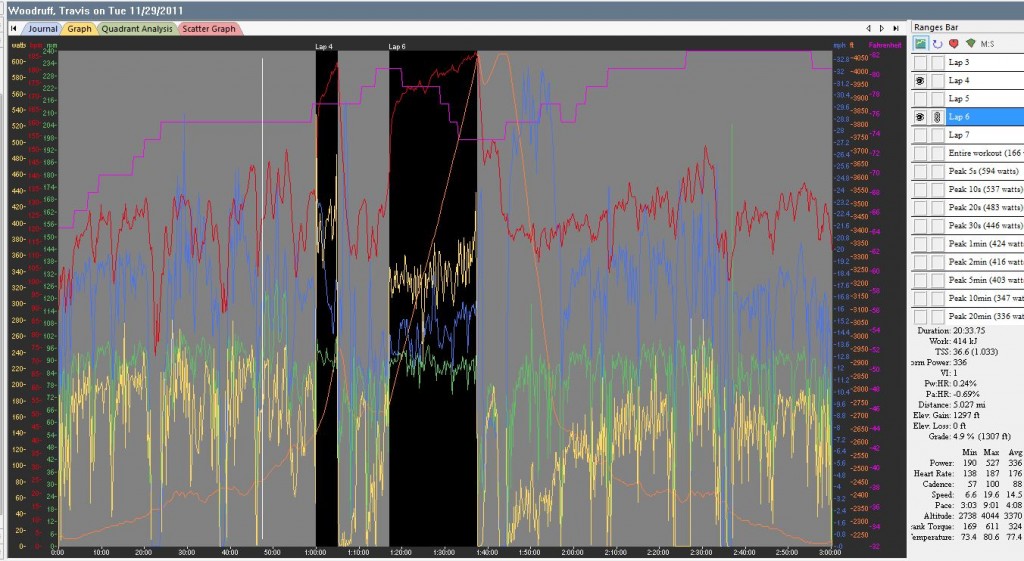
Having just wrapped up my cyclocross season I figured that it’d be a good time to test myself and see what my power profile is looking like.  The screen shot above shows efforts that were done at five and 20 minute durations, (testing VO2Max and Threshold fitness accordingly).  A second day of testing can be done to measure maximum one minute power and also your 10 second max effort, (which indicate Anaerobic Capacity and Neuromuscular Power respectively).

The collection of 10 second, 1 minute, 5 minute, and 20 minute data points is known as your Power Profile and can indicate where your unique strengths and weaknesses are.

Understanding what you can do for a single max effort is one thing, but how much fatigue are you able to withstand or how many repeated hard efforts can you serve out?  We can also test your fatigue resistance with workouts designed specifically to do just that.

Testing on a regular basis is a great way to measure the effectiveness of your training and the results can help us determine what training might be most appropriate for the next phase. Test often and train well!

-Travis


USA Cycling Mountain Bike Committee

Thanks to the votes received from other USA Cycling certified coaches, I was recently elected to the coach’s position on the USA Cycling Mountain Bike Committee. The committee exists to guide US mountain bike racing in the right direction and is comprised of eleven representatives, all coming from various realms within the sport.

I’m excited for this opportunity to serve USA Cycling members I and look forward to ensuring a healthy future for our sport. The first meeting that I’ll be attending will be October 10-12 in Colorado Springs.  As part of my nomination, here is the statement that I included:

“As an active USAC Level I coach and professional mountain bike racer, I am interested in fulfilling the ‘Coach’ position on the Mountain Bike Committee. Having the opportunity to work with juniors, seniors and masters alike, all of who compete at various levels and in various disciplines of our sport, I am highly motivated to serve USA Cycling members and ensure a healthy future for mountain bike racing.  It is important to me personally and professionally that USA Cycling serves the needs of its members and provides quality experiences for all of us to enjoy over the long-term.  As a full-time cycling coach who participates in races across the country it will be my goal to provide feedback and direction as to how USAC can improve upon its own work.  I am particularly interested in rider development and the pathways which exist for racers who are aspiring to compete on the National team. I appreciate your consideration and wish you the best of rides.”

Cross Training

And we’re not talking about the off-season type of cross training here…  We are talking about cyclocross training!  Local races are starting in Colorado, Illinois, and on the East Coast. Cross will be taking over the cycling world soon.  With the first USGP and local races everywhere just a few weeks away,  now is the time to start getting specific.

First and foremost I highly recommend going out and doing one or two easy runs per week.  A lot of people think there is a lot of running in cyclocross, however most of the time this is not the case. On a majority of courses you are off of your bike for five seconds, you run 15 feet, and then you are back on your bike.  In some races you may run uphill, while in others it’s flat over the barriers.  No matter the particulars of the course, the amount of running is most often limited to less than 30 seconds per lap.  This equals only three to five minutes per race. We recommend running in order to get the muscles prepared for the pounding they’ll experience during those first few steps off the bike.  When dismounting for a barrier at 15 mph eccentric muscle contractions in the legs act as your brakes when transitioning into your run stride. To prepare the leg muscles for this type of stress, a little running will go a long ways. By building up your running and cyclocross transitions gradually, you’ll reduce the risk of overuse injury too.  As you get further along into the season running becomes less important since you are probably racing on the weekends and practicing during the week – thus you’ll have plenty of cross-specific running built in already.

Secondly I recommend that you incorporate some cross-specific workouts into your plan.  Nothing on the road can replicate the specific efforts of cross racing. Making big accelerations out of grassy corners, the transition over the barriers, dismounting and remounting are all skills that can’t be practiced on the road bike. Plan to get out to your favorite park for a midweek workout.  Set up some barriers (easily made from PVC and portable too) and a short five to six minute lap so that you can race your buddies like there is $1,000,000 on the line!

The best part about cross season is that while the volume of training might be less, the intensity goes way up!  Lots of AC (Anaerobic Capacity) Intervals, Micro Intervals, and VO2 Max Intervals help to replicate racing intensity.  My favorite workout is the 30:30:30.  Ride over to your favorite cross course and setup a 90 second lap.  You’ll do thirty seconds at full speed on the bike, dismount, go 30 seconds full speed running (uphill), remount, do ten hard pedal strokes, and then 30 seconds of recovery. Repeat this cycle for six or seven laps.  The more fit you are the more six or seven lap sessions you’ll be able to do. Building up to three is a great goal while starting off with a just single set works best for most of us.

Whether you are racing fast for the stars and stripes jersey or racing fast to make it to the next beer hand up, cross is here and the time to train hard is now!

-Coach Brian

Motivation and Fall Training

Motivation is a big part (the biggest part perhaps) of what we do on our bikes.  We are motivated to keep fit, motivated to push ourselves and motivated to race as a chance to see where we stack up against the competition.   Motivation is never static and it’ll certainly have its peaks and valleys over the entirety of a long season.  For the most part, athletes (especially endurance athletes) are highly intrinsically motivated individuals. Why else would we voluntarily push ourselves so hard?  This general willingness to ‘do the work’ is what allows our fitness to build and our confidence to grow.

Motivation to train and motivation to race are independent of one another. Knowing how the two correlate in context to your race schedule is very helpful.  Consider how your motivation changes as the season progresses.  It should go without saying that motivation to train is always helpful for building fitness while motivation to race is necessary for your best results.  If and when you find a situation without any priority races in the near future and generally low motivation to train, it’s likely a good time to take a well-earned break.

If you’ve trained well, raced hard and had an excellent season then you’re likely due for some R&R this fall. It is important to recharge physically and mentally so that you can later kick off your 2012 campaign freshened up, motivated and ready to go.   If your season didn’t go as planned or if you encountered some setbacks along the way and you’re still motivated to ‘get it back’ then this fall will be an excellent opportunity to rebuild some fitness while the weather and daylight still allow.

The right fall training can include a number of different options for an even greater number of situations.  Consider your motivation and where things stand in the bigger picture.  Be sure to talk to Brian or I and we’ll steer you in the right direction so that you’re making the most of your training time and energy.  Riding is most fun when we’re doing it for all of the right reasons so let’s be sure that your fall plans are set accordingly.

-Coach Travis